Monday, February 18, 2013

Oil for the mind


“That’s so cool!!!” exclaimed my Ugandan friend Daniel Engole., BA, DJ, Copywriter, radio host, and one-time side-kick to an alleged Baganda Prince, when I told him that l had gone to Kampala last year to snoop around. But when I mentioned what I had gone to snoop around for - a quick oil dollar - he laughed out loud (lol).
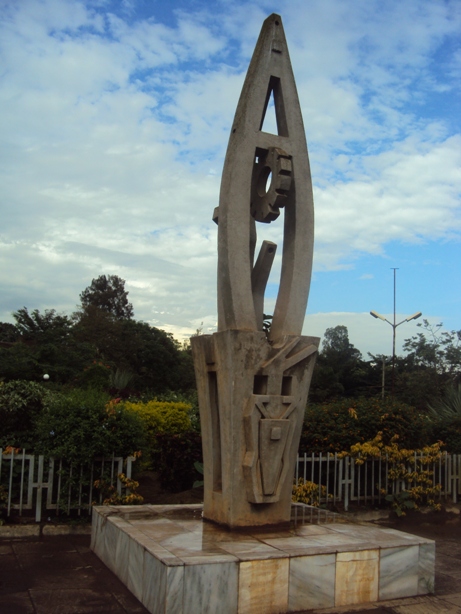
a beautiful monument and garden in Kampala city.
Photo by Lloyd Igane
He lol’d even louder (LOL), when I told him exactly what I found instead: a city with campaign posters (mostly of NRM yellow – it was elections time) pasted on every available surface and garbage in most corners. Daniel and I were, as the more perceptive of you have deduced, chatting online, and, following Uganda’s and then Kenya’s announcement that we were East Africa’s overnight oil sheikdoms, oil was on our minds.
 “Pathetic,” he typed, of the garbage. Or it could have been about something else; you never know with these chats. You triumphantly hit “send” on a rather lengthy sentence you have painstakingly typed for two minutes, eyes glued on the keyboard, only to look up and find your nimble-fingered chat-mate has already answered all the questions you had so laboured to ask and moved on to other things so different and more important that you feel rather silly.
Pathetic, however, also turns out to be the situation you could be in trying to find some food in that most noble of East African cities after midnight.
“Try the lower side,” offered an armed guard at a Bata shop on William Street (where I thought was the lower side).
Now I have been to Kampala many times, all before the 50th Independence Anniversary, I must add, and I have many lovely memories. I have eaten katogo for breakfast at many a restaurant, been spoilt with delicious, wholesome authentic Ugandan cuisine at Steak Out and hungrily gulped down juicy burgers and great coffee at various establishments of high repute; smoked a fake Sportsman under a deserted monument that, when later re-painted, turned out to be the Independence Monument, and gawped at M7’s amazing motorcade to the utter amazement of nonchalant Ugandans; made friends with a Crested Crane in the parking lot of a lakeside hotel in Entebbe, been a pilgrim at the GaddafiMosque, and among other things, pondered the cobblestones in front of the Parliament of Uganda building. I have also bribed my way (with impunity) through a double U turn and for inadvertently crossing the Nile at more than double the speed limit...
But nothing, friends and neighbours, had prepared me for that one night when I hit Kampala after midnight on one of my many uneventful trips through three countries in two days. Following the helpful watchman’s directions, I had pressed on, past a street corner where I had once bought a Ugandan maiden from Tororo two measures of live green insects (a delicacy, she had insisted), towards but not quite up to, the big central bus station. This, I realised, must be the side of town that my PR friend, John, had once described as “Any Time is Action Time street” and made me swear never to put a foot there or even say he told me.
Now I had put more than a foot there.
Unlike the relative stillness of the rest of the city, this had turned out to be a bubbling metropolis with a life all of its own. I was all of a sudden jostled from all angles by busy, highly active night people. Granted, some were lurking in dark corners and were not jostling anyone - probably because that’s how their business works - but even the lurking seemed active and darkly purposeful. Now I had heard talk in hushed tones of a Rock and a Garden on Nile Avenue, where the sun never sets etc and, for as little as USh 50k (Ksh. 150, Rwf. 17,000), or even nil, if he buys enough swallow and negotiates from the heart, a hard-up man can put down his load.  
I cannot swear by anyone’s milk that I was on said Nile Avenue, but I am not likely to forget the sights, smells and sounds: a most distinctly unsavoury smell wafted from a nearby garbage dump, fused easily with the general body odour/cheap perfume as the sensual background of what seemed to be scores of night clubs cum bars – all thumping and throbbing with an ear-splitting cacophony of high decibel sounds comparable only to the likes of Sabina Joy or the old Modern Green of Nairobi, Kigali’s Club Planet at the KBC and a certain Club in Nyamirambo to which Davie the Cow first took me on condition that I’d never say it by name in polite society.
Thus my hunt for a late night snack had progressively turned into an involuntary cruise of a shabbier version of Nairobi’s K Street, not just on a very busy night but with several Sabina Joys, MGs and Club Skys (oops!) thrown in. Business looked (and sounded) really good. Unfortunately for me, the only business seemed to be alcohol, illicit sax, who-knows-what-else, and then more.
            “Are you looking for a man?” asked a snake eyed man clad in tight blue jeans. He also looked anaemic and had very bad teeth.
            “No sir,” I managed to say through gritted teeth, “just a cup of tea, is all.”
            “And after that am all yours?” he persisted, batting his badly done eye-lashes at the night and bleakly flashing his tobacco-stained teeth – a trick that seemed to have backfired many times but which he was doggedly determined to perfect with practice. I wondered if he had a concealed knife but didn’t let it bother me.
            “After that,” I almost shouted, but didn’t, “you go suck a bee.”
When tottering on the brink of insanity in a strange neighbourhood, showing your emotions can only make things worse.
            But I digress, which is good, really. More presently, Danny boy was still LOL-ing about the yellow posters.  
            Me: Is it true that the posters were all gratis?”
Dan: Don’t know.
Me: But someone from a billboard company told me they had to donate some prime sites...
27425_604852728_5572_q            Dan: Hahahahha. Dictator... do it or ...
            Me:  Try strategist.
            Dan: Poltergeist LOL. To M7, it’s still a war... always a war.
Me: Naa.
Dan: 157578_703603045_2246045_qDeals?
Me: Correct. But I worry for Uganda.
Dan: We’ve got oil, dude!
Me: Especially that…
Dan:  ???
Me: Once the oil starts flowing, I fear the queues may suddenly appear at petrol stations like they do in Lagos.
 Dan: That’s the order of African legacies lately...
(Author’s Note: I’ll never put Daniel E in a story of mine again. He is too unpatriotic and passively negative.)


kreative@publicist.com


27425_604852728_5572_q
157578_703603045_2246045_q

Saturday, December 3, 2011

Just a little click is all it took to render me penniless


To all the followers of what I flippantly call my blog – all four and a half of you – my utmost apologies for not being more expressive on matters close to your heart – like breastfeeding, politics, religion, sex, money etc. (You brought it upon yourself; how would I know what you want to read about if you hardly comment or say much to show me you’re still there; acting as if the word interactive means absolutely zilch to you – after all, it is only just the main pedestal upon which the Information Age rests its big bottom, hello!) but my utmost apologies all the same, if only just because I just ranted at you in full hearing of my esteemed reader – your mind.

As for not being more regular, I have only one word for you: Go.walk.it.off!

Having thus dispensed with that, let’s now move on to matters of national importance. And that’s my earnest appeal to all of you to help in a battle to join the ranks of all these other bloggers who keep splashing mud at me as they pass by in their expensive gas-guzzling monsters which they claim to have bought through big cheques from Google and Google Adsense and other rich places like that, which by the way own blogspot.com and a few other Porsche-buying companies (for their directors; believe me, I’ve checked.) Anyhow, to cut a long story short, I’ll bite the bullet and spit it out: All you have to do is sign (by adding your name and forwarding) a petition confirming that I am  a total mohine; totally worthless in matters of blogging and web surfing for that matter; that many a times in the past, I have impulsively and mercilessly clicked on and subscribed to almost anything I found free on the web and some that are not (it is two years since Jobs In Dubai promised to refund my deposit after failing to get me a job - well, they claim to have hawked my CV all over the middle east and Canada with hardly any bites; I don’t blame them; all I want is my money back and they keep telling me to ask for it, which I do and they don’t  refund!); and especially that when I clicked on the few ads that appeared on my blog space while it was in its infancy, I didn’t know it was wrong and yes, I had clicked “Accept” on Terms and Conditions of  Google Adsense but not quite noticed that they prohibited me from clicking on ads on my page. 

That’s all really, thank you. I am not asking for much. If that doesn’t work, then I guess I have to ask Wanjohi wa Kigogoine how he does it without them rich buggers; then I can escape this pennilessness that’s literally caused by “just a click.” 

Send the completed petition to kreative@earthling.net 


Friday, July 8, 2011

Why Athi River is no place to bring up a young donkey

Early in the morning in Athi River, a young donkey wakes up, stretches his muscles by making a few hee-haws, trots a little way down the road, and digs in for breakfast; his meal of choice, a sprawling heap of garbage behind a block of flats. He has commandeered this particular heap and seems to have grandiose territorial plans for it. Every donkey, he seems to say, to his own garbage heap, and to hell with anyone who wishes to move in on mine, as if there were not enough garbage heaps in Athi River for each and every donkey, monkey and mangy dog worth his/her tail.
But there is no blaming the donkey for being a little selfish. Heck, you would be selfish about your breakfast too if you spent every working hour supplying hoof-power to an ungrateful Athi River Donkey-cart Driver and had no choice to either escape to the KSPCA stables in Langata or run off to the Animal Orphanage, where you can conspire with the wardens to paint your butt scarlet and exhibit yourself as a Doboon (donkey-baboon) right there beside the Zeedonk (Zonkey) and the Zoryx; anything to escape the daily bodily and psychological abuse that is supplying hoof power at the hands of the ruthless, greedy and super-fast donkey-cart drivers of Athi River, but more about that later.
In the evenings, when it is unsafe to be on the road with an unlit cart-load of water, the donkeys of Athi roam the grassy patches of the residential areas in twos or threes, browsing quietly on every blade of grass they can lay their maws on and every bit of garbage they deem edible. They roam the plains aimlessly, feeding, mating and generally enjoying their temporary reprieve until when it’s almost dark, time to form a single file, muzzling each other with their noses as they quietly trudge home, none ever daring to wander off.
“That’s what the beating does to them,” explains Hamisi, who has spent some time around donkeys in Lamu. ”It tames them, makes them obedient and loyal.”  
Looking at the donkey’s dark sad eyes as he digs into his garbage heap breakfast, it’s not hard to imagine the humble beast recalling something terrible about a tail but not quite putting a hoof on it, and - with a ruminative flap of his long ears –dismissing the thought altogether and putting his head down to continue chomping at bits of discarded diaper etc. He knows that soon, the young tout employed to run him will come hurrying like an MP who is late for a meeting about tax evasion and tie him to a blue cart full of plastic jerry cans for the next twelve hours. He knows he will need all the energy he can get. So, chomp, chomp, chomp!
            At this point, this story shifts perspective and stops being told from a donkey’s point of view – beyond here, it would not be a good idea for the human reader to continue to imagine being a donkey in Athi River; not with the perennial water shortage, it is not. 
“Sometimes I think the shortage is artificial,” says Hamisi in his coastal Swahili. “The water sellers and the transporters may all be working together to hold the residents hostage,” he adds bitterly.
Further attempts to get more specific statements from him and his buddies at the water kiosk quickly degenerate into the usual vague pronouncements about shadowy civic leaders and village elders and their strategies of making things scarce so they can make money out of them. It becomes, in other words, political– not good.
Quite curiously, it also calls to mind a depressingly desperate but unrelated case that took place a long time ago in the village where I grew up, when the community water taps suddenly went dry after we had spent a lot of money to ensure they never would, and we suspected a rich and respected elder of diverting the water to his coffee factory and other water-intensive projects to the detriment of everyone downhill– a good thing to call to mind, but also political, so not good either.
So let’s not talk about who owns the many tankers of “Clean Soft Water” delivered every day in the dusty little place that’s not exactly a town but a collection of little dwellings (and a few big ones) and cement factories and steel plants and railway crossings; neither digress any further and discuss a certain trusted church elder in a village far away (even though our suspicions were later confirmed by his children when we all grew up).
Let’s instead finish the story about the trouble with being a donkey in Athi River.
And the vicious ways of the wickedly ruthless, greedy and fast donkey-cart drivers that run their lives.
You see, the faster a donkey-cart driver, the more jerry-cans of water he delivers, the more money he makes – just like a matatu driver on any busy route. Unfortunately for the donkey, the donkey-cart driver knows no other way to be the fastest and richest on the circuit but to clobber the donkey harder and harder. So, the faster the cart, the worse the beating the donkey gets.
In actual fact, only last year, one of the fastest donkey-cart drivers beat his donkeys so much that he not only split both ears of one but clean chopped the tail off the other. Ask anyone in Athi River Makandara where the two donkeys are frequently sighted to the horror of residents and visitors.
(Authours Note: For the sake of all the hardworking donkeys of Athi River, we can only hope that Jean Gilchrist is still at the KSPCA and is reading this.)

Wednesday, May 4, 2011

Nostalgic Thoughts of Mafaranga Menshi


A sunset on Lake Kivu

          Less than a month since yours sometimes took to much needed rest in the Mavoko Municipality of Athi River, there are still aspects of my country of refuge that I miss dearly.  Except for the dust, which is just that, and the heat, which we’ve learned to adapt to, Athi River is great; so great you can describe it by paraphrasing a Mr Matthews who, when explaining to a National Geographic writer why Karen is so great, said: “From here, you can see Nairobi; but you can’t hear or smell it.”
Most peaceful too: During the 2007/8 post election violence, when chaos took over Nairobi, life here went on as if nothing had happened and Nairobians would come to shop in our supermarkets after theirs were barred against or destroyed by marauding looters. Here, donkeys, camels, cows, goats, sheep, zebra, kudu and part-time human beings are not just picture book illustrations for kids, but everyday realities that one actually shares a municipality with.
            Still, I miss the place that became my post-post-election-violence economic refuge. Most of all, I miss my friends from Kigali – both the +254 variety and the beautiful, gentle people of Rwandan extraction, whose graciousness is only equalled by their inscrutability.  I miss the sound of people addressing each and all in Chinyarwanda – with neither a sense of arrogance nor embarrassment – as if it were Swahili or some other regionally recognisable language (like, say, Kikuyu or Dholuo?); I miss the smooth, newly tarred roads; the jam-free vehicular traffic snaking its nevertheless slow way around the hilly city of Kigali; the unique architecture that seamlessly blends the traditional and the modern; the feeling of always sitting on one hill contemplating another; the gorillas; sunsets on Lake Kivu; the Canopy Walk in Nyungwe; the temperate climate that makes you want to burst into spontaneous applause as rainbows arch dramatically between one distant hill and another … But top of my miss-list is the word Mafaranga, which tends to become part of the background noise wherever there are people talking. True story: every few words in a Kinyarwanda conversation, radio or tv broadcast, political or motivational speech, are more often than not punctuated with the word.
            Now I am no gambling man, but I am willing to bet the hut that mafaranga (francs), Kinyarwanda for cash, is clearly the most commonly uttered word in the language. The casual observer quickly catches on that most of the time you hear the word, it is accompanied by the word “yange”(mine). Hence “Mafaranga yange” are the last words you’ll hear from an irate Rwandan before he/she calls the police or the Mudugudu leader on you for not coughing up what belongs to him/her cash-wise.
The word also regularly appears as mfaranga menshi (lots of money) which aptly describes the cost of items on sale that are more expensive because they come from Kenya – or the kind of money you are expected to command if you come from Kenya. Incidentally, mafaranga menshi is what you pay in fines if you are caught speeding (over 40 kph within city limits), or parked in a no parking zone. It is certainly not what you are expected to pay as entry fee for your car when you drive into the country; but it could easily refer to what you are likely to pay in fines if you don’t renew your foreign registered car’s entry permit once it expires, as I once learned the hard way.
            “You have not renewed your entry permit,” said the policeman who had waved me down. He was scowling at the temporary importation papers I had obtained at the border slightly over a month before, even though the permits used to be valid for only two weeks then. (The new EAC rules later made the entry permit free and valid for at least 3 months but were vague about thereafter)
            “But why,” I had asked, feigning confusion, “do I need an entry permit when I am already inside? I paid at the border. Entry…,” I demonstrated with my hands. “Please let me go. I am late for an appointment.”
            “It is expired,” explained the second policeman patiently like he thought I was retarded, “you are supposed to get the car out of the country. If you wish, you can drive it back in again.”
            “You mean pretend to leave?”
            Needless to say, I never made it to that appointment. The policemen, both from the Revenue Protection Unit, had boarded my little white car like two officially sanctioned pirates and ordered me to drive to a yard from which I couldn’t get the car until I had paid the mafaranga menshi fine and signed a note that came with it. Written in Kinyarwanda, the note simply stated that this offending car was to be driven back to its home (Kenya) within 24 hours. It did not go on to say “or else”, but you could be sure that the consequences of disobeying such a note would be even more mafaranga.  
By an unfortunate coincidence, mafaranga menshi also refers to the price of almost anything good that you would like to buy at the grocery shops or supermarkets or hardware shops or restaurants, in Kigali. When news from reached us from Kenya that riots were about to start because a bag of maize flour had hit the 120 bob mark, us Kigalians were quietly paying the mafaranga equivalent of 186.50 Kenya shillings for the very same bag of flour.
 Sadly however, the salaries of most people in the country do not even remotely resemble mafaranga menshi. But you won’t hear an Atwoli threatening uncle Paul with mass action; never. In fact I bet there are no Atwolis there. What you will occasionally overhear are the hushed tones of shrewd investors referring to the “low cost of local labour” as they sample delicate meats in exotic hotels with names like “Heaven” or “Republika” or Shokola. And as they chase the said meats down with expensive wines and tap their expensively shod feet to the piped jazz oozing out of hidden speakers, they explain to you how easy it is to make mafaranga menshi in Rwanda. In fact, many are the Kenyans who have done just that in the fast growing, hilly little country, whose capital city is characterised by an armed soldier/policeman every few hundred metres.
Yes, in the country of mafaranga, just like in Athi River, you can walk around unmolested any time of day or night as long as your intentions are good and you are not (in the case of Rwanda) within 100 metres of the President’s office – but that’s another story for another day (hopefully someone will pay mafaranga menshi for it.)

© Lloyd Igane, Nairobi 03/04/2011

Tuesday, April 26, 2011

The Kingly Well That Never Dries


A local pilgrim gets his dose of kingliness

Our discovery of the well that never dries up and its spiritual significance was some kind of side issue. In all the literature we had read and the lectures we had attended, nowhere had we come across the story of a magical well. Not even in the highly acclaimed Threatened Kingdom, The story of the mountain gorilla, a rather glossy coffee table book we had earlier received, compliments of our host.  In fact, we had only driven down here in Eugene’s SUV to be shown the lower entrance into the Muhanga Forest, where the traditional King of Rwanda is said to have spent his last night before taking office.


“We” is a bunch of us intrepid ad agency types, all foreign, crisscrossing the vast Rwandan district of Musanze, marvelling at the wonderful things that the International Gorilla Conservation Project (IGCP) have done with (and for) the communities in the gorilla conservation areas. Eugene is the mild mannered gentleman from IGCP handling the logistics of the trip and acting as translator/host. As we wait for the game ranger in charge of this entrance to the seemingly impenetrable forest, people keep coming down to some kind of hole in the ground at the edge of the forest, draw water in plastic containers of all sorts and disappear back into the village after staring curiously at us. If we paid more attention, we would notice the reverence with which they approach the simple task.
Speaking through our interpreter, the old ranger – when he finally turns up – tells us how so sacred to the nation of Rwandans this part of Muhanga forest was in the old days. “The new King would spend his last night here before being enthroned,” translated Eugene. “He would take that time of solitude to receive instructions from ancestral spirits believed to have lived here, and in the morning, he would take a bath in the magical water in that well,” he pauses, pointing a long index finger at the decrepit pit at which all those people continue to fetch little amounts of water…
“So that water has kingliness in it?” exclaims Dudu Thabede, our fearless leader from Jo’burg, SA, and starts to walk towards the well, “can we get some?” she adds, changing direction and heading towards the vehicle for discarded mineral water bottles.
 “Get me the biggest bottle,” jokes Sinty Zulu, “so me and these guys (he wryly eyes some of the scrawnier and more shabbily dressed people filing reverently to the open well) will be Kings tomorrow!” A  Zimbabwean, he is the next most foreign of us all and officially the office wag. Most things about Rwanda amaze him to bits; not least of them the ability of Rwandans or anyone to move that slowly. “So why doesn’t anyone bottle it and brand it and sell it?” he asks, suddenly thinking about branding in the middle of all this.
Yakub and I, the east africans awaiting the ranger
“Someone even tried to pipe it for distribution,” explains Eugene after some Kinyarwanda consultation with the old ranger. “But the well is said to have withheld its water. When the piped water project was scrapped, the water mysteriously came back.” 
Sinti and our writer pose with the local pilgrims.
Ugandan Yakub Ibrahim and I, the rest of the team, are fellow East Africans, and are trying not to sound too much like tourists as we crowd around the well, mingling with the regular pilgrims.
“She says it keeps her family free of common illnesses and promotes ubuzima – general wellbeing,” Eugene translates again.
“Not many people including Rwandans know the story of this well,” explains Eugene as we drive off, each clutching a bottleful of kingliness. “We hope that you guys will create communication that spreads the world.”
Dudu, fearless leader, with her share of the well

“We certainly will,” says Dudu, “especially after a daily morning sip of this kingly water.”
But as we drive back to Kigali the next morning, we can not help but think of how we are going to exist beyond the next day without the bottled magic from the kingly well that never dries up. This is because when we left our precious bottles in our rooms as we went for breakfast, the cleaning staff mistook our kingly water for old mineral water and replaced them with fresh, unopened ones!
©Lloyd Igane 2011; kreative@publicist.com

Tuesday, April 12, 2011

“BRILLIANT KENYAN PIANIST” LIGHTENS UP KIGALI

Kim Thuita connecting with his audience


“If you are in Kigali, ask me about Kim Thuita.”
-         Recent Facebook post by Anjichi David, an excitable thirtyish Kenya-Rwandan

Meanwhile, at Chez Robert Restaurant in the Kyovu suburb of Kigali, a tall,, dark teetotaller Kenyan pianist adjusts his trade mark little black leather hat that precariously balances on his almost-clean-shaven head, smiles at the crowd, hits a few bars on his electronic key board and croaks the words of a very old tune, like say, Fadhili Williams, or Frank Sinatra... The crowd roars in spontaneous applause and starts waving its collective drink-laden arms in the air; like worshippers getting carried away by the spirit during Holy Communion.
Mutsari Mrefu winging it gleefully
A few heartbeats behind the pianist, Mtsari Mrefu (long queue/long arrow?), a well known Rwandan entertainer joins in with his bass guitar. He winks at the crowd and garrulously wings some of the words as the song is picked up by the audience. The audience, consisting of relaxed middle-level and senior executives, cheers some more and soon, almost everyone – including those who normally sit in pubs and vegetate – is itching to dance; even those who, like me, don’t know much about jazz, rhythm and blues.
“It’s all about communication” says Kim Thuita, the tall dark pianist, with an entertainer’s easy smile, “Music is all about communication. You can sit there and play the best compositions and combinations in the world,” he adds, “but if you are not communicating and really connecting with the audience, you are wasting your time… and theirs. They can hear you, but they can’t feel you.”
 “People need to lighten up…,” continues Kim with passion (it’s not easy to stop him talking about music once he starts),“and the only way I can give that is through music.”
And from the way not only David and his young girlfriend, but also Beatrice of the Peace Rose fame and all the patrons at Chez Robert in general are getting down tonight, the people of Kigali not only feel this world class entertainer (from Kenya); they also lighten up quite a notch. All sorts of people who are normally stiff and officious during the day let down their guards and boogie to the rhythm of Kim’s piano.
Let’s face it though: my insistence on Kim’s Kenyan roots is and Anjichi’s sense of  ownership are, I realise, nothing to do with his having played in Kenya for almost 15 years before venturing out; more like a vain attempt to reclaim a brother who has done well for himself… At the Calle El Arsenal in Managua (across from the San Francisco Convent) where “reservations are appreciated”, he was billed as “En Concierto Kim Thuita (Hollanda), Jazz, Fusion and Blues – Fusion deSabores”. Never mind all the Latin – they think he is Dutch! This is probably because the Nicaraguans did not care to understand that a Kenyan pianist married to a Dutch diplomat doesn’t automatically stop being Kenyan.
Not that it bothers Kim.
“I just have to strike a good balance,” he explains, guiltily checking his watch as he’s getting late to go pick up his children from school, “between my family and my music.”
Wherever his wife’s duties as a diplomat with the Dutch embassy take the family, Kim just finds classy venues with bars in them and plays his music at them.
“Music is universal language,” he explains. And whether it is Maputo with occasional crossings to Cape Town and Johannesburg, or in Iran where the no-alcohol no-clubbing Islamic rules limit one strictly to the house party circuit of the diplomatic community; or in Nicaragua, where he carried on Nica Soul to reservations-only crowds; Kim has jammed with the locals and thrilled the patrons of many a classy joint. And in all those places, he went with an open mind and let the local tastes influence him.
“In the next four years,” he claims, I believe I will have found ways to tap into the Intore Dance Troupes. Oh, they are so graceful!” he adds with respect.
That, and to open a nice club of his own…
“Mozambique is the haven of Afro jazz while Cape Town is known for it’s jazz and Kwaito,” Kim is talking about the places he has been and how they have influenced him; you are where you have played! “Nicaragua with its Latin Groove, Mambo and Salsa, you know the craziness of Central America with all its influences… I have been blessed,” he confesses, echoing some of the origins of his musical career.
Although he made himself a name playing the piano and crooning to residents and guests at the InterCont and the Serena in Nairobi, his first public performances were at Valley Road Church (Jesus Is the Answer). As for the true genesis of his musical career however, Kim has only two words:.
“At home,” he says meekly and chuckles mischievously in afterthought. “It’s a family thing. It is in the blood. We all used to sing – my bothers, my sister, and even my mother who couldn’t hold a tune…” he breaks off laughing at his mother’s musical disability. Dad was the main influence,” he elaborates.
Dad, Charles Thuita, was a “musician, arranger, choir conductor and singer” of quite some note, it turns out.
So they all took up musical careers?
“Not really,” explains Kim. “But we ended up having something to do with music. My brother Andrew is the one who actually took up a musical career. He is a professor of classical Music in the US; Seth is an architect in the UK but he is an accomplished guitarist and singer. And my sister G Net Perez is a singer in Madrid – yes she married DJ Paco Perez of Club Boomerang”;
And Kim was the one that chose to be a bank clerk who plays piano at the church on occasion; then a bank clerk who plays piano at classy joints, and finally, a pianist who plays at classy joints, period.
“When I started to play piano at the Valley Road Church on Sundays, I never considered doing it full time for a living. It was only after I got a gig at the Serena, playing at the poolside Mandhari Restaurant that the thought of quitting my clerical job started occurring to me. But still, I didn’t quit until I got the contract with Intercontinental. My parents were mad at me for a bit until they saw how fast my lifestyle was improving as a musician as opposed to a bank clerk who only plays occasionally...”
Many years later, although Kim has played in all those countries, has three scheduled gigs a week in Kigali and invitations to play at almost every major social and business event in the hilly city, he still remembers with nostalgia, his days at the Intercontinental where it really all began.
““Originally, I was only playing during the high tea in the afternoon,” he reminisces, a slight whine in his voice suggesting boredom. “Then I approached the management and offered to liven up the evenings with a little jazz…”  To cut a long story short, Kim, and his buddies – Lucas on bass and JB on drums -  calling themselves Jazz Q, started the Jazz Nite at the Intercont Bar, and evenings at the hotel changed for good.             “When the hotel realised it helped them retain more business as airline crews and other guests (who used to take their trade elsewhere) now spent their evenings at the hotel, they supported the idea fully…They sent me out to buy better equipment and we were on a roll!”
Not much later, the Salsa classes began at the Intercont, setting the pace for Nairobi, as soon, everywhere you looked, Salsa classes were swinging into existence!
But that is all history now that only lives with Kim as pleasant memories.
Now when I tell him that people are describing him as “that brilliant Kenyan pianist,” Kim Thuita just chuckles self-dismissively and says, “I’m just blessed, I guess.”
1326
 ©Lloyd Igane 2011