Saturday, April 27, 2013

What the WhatsApp! ( When your electronic guide to the Galaxy packs up!)


The IgMy Manyatta before Ekiru the terrible Turk(ana) repaired it.

Like I've said before on this blog, and as the more perceptive of my readers (all ten of them!) may well know, we are now in the multi-dimensional age of intergalactic governments, Big Brother, beyond 1984 and so forth. Anyone with a hand-held pocket-friendly device can instantly insult or be nice to any number of other someones in any number of places in the known world and, ever since space travel went commercial with the launch of Virgin Galactica, space and time myths of years gone by have been smashed to smithereens.

I was sharply reminded of this yesterday when my hand-held guide to the galaxy in the shape of a Nokia Asha packed up in the middle of a conversation with a girl sitting on Nyamurembe hill in M7land and another at a glitzy wine tasting event in  in Stellenbosch, Western Cape.  I was also trying to reason with my teenage daughter about something important and halfway through an article about muses and how they were considered the nine daughters of Zeus which was supposed to help me with stuff I am not supposed to tell you..

Panic!

But panic at times is what we need to be inventive; to think in a tangent, to reinvent our environment. So  I thought of all those things I could do and don’t do now because I’ve got my electronic device: the magazines about disease that I used to read at the reception areas of medical clinics, the personal errands I used to run and the freedom I had of not being available to the world all the time, but most of all, it just occurred to me that I should be writing my new look blog.

So I dropped the phone turned to my word processor, but was sidelined by a few jacaranda seedlings that  needed planting. I stuck them in the ground and added some humus from what formerly used to be my Maasai manyatta before one heavy bout of rain brought it crashing down. This was as a result of an unfortunate encounter with a Turkana moran called Ekiru, who had insisted on piling mud on the manyatta’s roof, saying that the cow dung used by the Maasai was not as good as the mud they (the Turkana) use for their dwellings. 

Besides providing all the humus I ever needed for mock agriculture and landscaping for my republic, the manyatta also has the two dubious distinctions, being not only the shortest-lived of all human dwellings ever built in my neighbourhood, but also the structure after which our area was named (see Manyatta, Athi river on Google Maps). It has ever since been replaced by the hut, which I may or may not attempt to write about next. 

Meanwhile, may I recommend that you check out  http://amolosart.blogspot.com. It may change your mind about a lot of stuff. Buy her pictures even (if you can understand them!).

Thursday, April 25, 2013

(Not) A Cat Called Pussy


But for a chance meeting with a Lake Goddess of remarkable charm and beauty, I was going to write a long winding story about a cat called Pussy. Then she taught me something that had escaped the murky shallowness of my excuse for a mind: "With so much to read on the web, the less words one writes, the higher their readership; it helps if one can draw stick people..."

So this is me, writing as little as I can so that you may read me, then tell your friends and neighbours what an under-writer I am so they can also tell others and so forth and so forth and before you know it,  I’ll be back on AdSense pap! Say bye-bye to long travelogue-adventure-rant-caper stories with twists and turns about things you may never get to experience, unless, of course, you are as daft as I tend to be most of the time. 

I may occasionally backslide in this new faith however, especially if the iconic Linus Gitahi has already paid for a long story and put it in The East African (or The Galactic Times!) first. Not personally, of course. He has people for that. Heck, LG has people (for all sorts of things) who in turn have people who have people that also have machines for that - that being little stuff like laying text and pictures for long stories in newspapers, or binning them if they are too short; like this one that's not even remotely about a cat called anything!.  
Ends. 


Monday, February 18, 2013

Policemen and thieves and how to travel through Uganda without hotel bills


Ole Samurai prepares to be lodgings for the night
“Are you going to leave at four or five?” asked the man with the gun and the Security Group hoodie.
I was lost for a bit there because all I had asked him was where I could find some reasonably priced accommodation in the neighbourhood of the petrol station he was guarding. “You just give me a thousand,” he added.
            “Uganda shillings?” I asked, finally catching his drift.
            “Yes, U shillings,” he confirmed with a self-satisfied grin. “You won’t be alone, see?” he went on and, pointing with the barrel of his gun at three cars, four matatus (communal taxis) and a luxury Toyota mini van. “There are people in those cars and they will continue to Kampala early tomorrow morning_____”
            “And of course we will be safe because you have a gun?” I asked, interrupting his pitch; why let the man continue preaching to the deaconry, right? “Here is two thousand,” I added to his delightful surprise, “one for your hospitality, the other for the idea.”
He beamed at me.
very thoughtfully, in case you need to freshen up .....
“And if you wish to freshen up before you sleep,” he said most hospitably, while leading me to where there was a long-snouted plastic container and basin, “you just come here.
As promised by the askari with a gun, Ole Samurai and I spent a peaceful and rather uneventful night together (one inside the other, to be precise) at the Bugiri Petrol Station on the Malaba Kampala Highway.
The discovery early in the morning that there was a running tap under the water tank and even better, a working bathroom next to the tank, was purely accidental, but a welcome bonus.
My Ugandan friend in Kampala however didn’t seem impressed.
“It’s legal nowadays,” he said nonchalantly when I explained how I’d never waste money on hotel rooms again. “They changed the law just the other day to allow travellers to sleep in their cars. Otherwise you would have been arrested for jaywalking.”
Jaywalking indeed!
As if they would give a hoot! Except in the city of Kampala where my most organised always-travel-with-a-map brother Muthomi was once delayed for almost an hour for carrying an expired driving licence,  the policemen of Uganda are generally very well disposed towards people with Kenyan plates on their cars.
“Habari my friend,” said the first ever Ugandan highway patrolman to wave me down. ”How is Kenya?” he shouted as he hurried to catch up and come to my window.
“Kenya is good.”
Wapi chai yangu?” (Where is my tea?).
Just like that, without even looking at my cracked windscreen, or scrutinising my then expired driver’s licence and insurance! The total lack of shame with which he uttered this last statement, despite the fact that tea is the oldest euphemism for a bribe in Kenya, is the true definition of impunity. So with a smile that said “no offense, officer but you’re being silly,” I let him have it.
 “Did someone inform you I was bringing it?”
 “These crazy Kenyans!” he exclaimed to no one in particular. He waved his hands wildly in the air in dismay at our craziness. “Have a safe journey,” he added as he waved me on, with a look almost of pity in his eyes.
Henceforth, I have adopted the retort “did someone say I was bringing it?” as standard response to anyone who asks me for “my tea.” Try it some time, but not on a Kenyan traffic policeman. The fines, both legal and illegal, can be too steep for that kind of talk – especially with the tough new laws.
But this is not about the Kenyan police. It the story of how I spent a restful night at Bugiri petrol Station during one uneventful journey through Uganda. On this trip, friends and neighbours, I was also to find out that Rwandan plates driving through Uganda do not command the same respect as Kenyan plates do. This may explain why, on reaching Kampala the next morning, I had to part with Ushs. 20,000 (Ksh 800) for making a simple S turn. (What? Never heard of an S turn? It’s when you make an illegal U turn, realise your mistake and make another to correct the first one.)
The male and female cop that caught me were friendly though, and made small talk about Paul Kagame and how he had fallen out with M7 for a long time until their wives orchestrated reconciliation. And after the cash had disappeared into their dark trench coats, they even wanted my phone number so we could keep in touch. I lied of course; gave them the wrong number by two digits!
Nothing amusing though about the next bunch of Ugandan cops that stopped me later that day. Having taken some time to have the old junk’s suspension checked, I had left Kampala at around seven pm and hoped to do at least four hours of the nine hour journey before finding a friendly petrol station to pitch camp at for the night. It happened on a rough stretch of road less than three hours after leaving the city.
It was a bit confusing and rather scary, not just because the “policemen,” just materialised out of the bushes and had no actual uniforms to speak of safe for worn out army issue jungle jackets, but because they were armed with only a torch with a watery weak beam and were not beneath pleading, nay, begging, for at least USh 2,000 (Ksh. 60)
Ati leasti,” said one, meaning “at least” and playing the torch on the back seat of the jeep,”2000 will help us purchesi the batteries for thisi torchi. Iti is for your safety, ssebo.” He moved around to inspect my meagre cargo better. “Nobody cares abouti us out here,” he added getting back to my window.
Something, I realised, was not quite right.
But it didn’t hit me until just when I was handing over my USh 1000 donation for their Police Torch Fund. It was only then that I took off as fast as my 20 year old jeep could.
It was their furtive gestures, darting eye movements, faltering English and confidence levels that tended to rise and fall as we haggled that had set my hairs aflutter and set alarm bells in my head. Moments later, my intuition was proven right when out of the bushes came two big motorbikes with bad engines. They gave chase for about a kilometre then fell back.
“.... many highway robbers on that section of road,” said the armed guard at the next petrol station when I narrated my experience as I handed over my last 1000 U shillings for the overnight truck stop. 
As I settled for another uneventful night’s sleep, I couldn’t help feeling very lucky. Even luckier that the next day I would be in Kigali , Rwanda, kwa Paul Kagame, where a man can go unmolested anywhere, any time of day or night, and cops don’t ask for Chai for fear of dismissal and jail.

© Lloyd Igane; Nairobi 2012

kreative@earthling.net


Oil for the mind


“That’s so cool!!!” exclaimed my Ugandan friend Daniel Engole., BA, DJ, Copywriter, radio host, and one-time side-kick to an alleged Baganda Prince, when I told him that l had gone to Kampala last year to snoop around. But when I mentioned what I had gone to snoop around for - a quick oil dollar - he laughed out loud (lol).
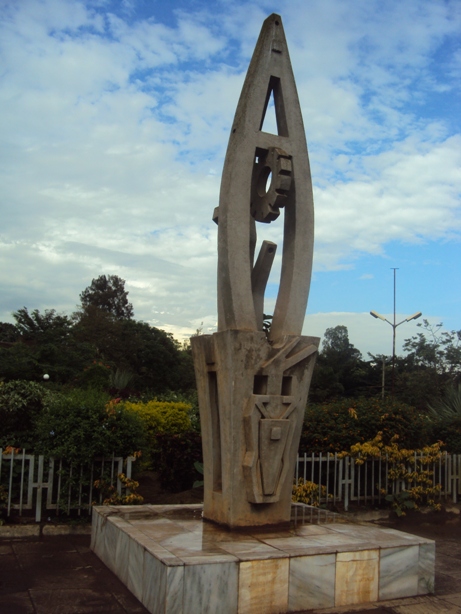
a beautiful monument and garden in Kampala city.
Photo by Lloyd Igane
He lol’d even louder (LOL), when I told him exactly what I found instead: a city with campaign posters (mostly of NRM yellow – it was elections time) pasted on every available surface and garbage in most corners. Daniel and I were, as the more perceptive of you have deduced, chatting online, and, following Uganda’s and then Kenya’s announcement that we were East Africa’s overnight oil sheikdoms, oil was on our minds.
 “Pathetic,” he typed, of the garbage. Or it could have been about something else; you never know with these chats. You triumphantly hit “send” on a rather lengthy sentence you have painstakingly typed for two minutes, eyes glued on the keyboard, only to look up and find your nimble-fingered chat-mate has already answered all the questions you had so laboured to ask and moved on to other things so different and more important that you feel rather silly.
Pathetic, however, also turns out to be the situation you could be in trying to find some food in that most noble of East African cities after midnight.
“Try the lower side,” offered an armed guard at a Bata shop on William Street (where I thought was the lower side).
Now I have been to Kampala many times, all before the 50th Independence Anniversary, I must add, and I have many lovely memories. I have eaten katogo for breakfast at many a restaurant, been spoilt with delicious, wholesome authentic Ugandan cuisine at Steak Out and hungrily gulped down juicy burgers and great coffee at various establishments of high repute; smoked a fake Sportsman under a deserted monument that, when later re-painted, turned out to be the Independence Monument, and gawped at M7’s amazing motorcade to the utter amazement of nonchalant Ugandans; made friends with a Crested Crane in the parking lot of a lakeside hotel in Entebbe, been a pilgrim at the GaddafiMosque, and among other things, pondered the cobblestones in front of the Parliament of Uganda building. I have also bribed my way (with impunity) through a double U turn and for inadvertently crossing the Nile at more than double the speed limit...
But nothing, friends and neighbours, had prepared me for that one night when I hit Kampala after midnight on one of my many uneventful trips through three countries in two days. Following the helpful watchman’s directions, I had pressed on, past a street corner where I had once bought a Ugandan maiden from Tororo two measures of live green insects (a delicacy, she had insisted), towards but not quite up to, the big central bus station. This, I realised, must be the side of town that my PR friend, John, had once described as “Any Time is Action Time street” and made me swear never to put a foot there or even say he told me.
Now I had put more than a foot there.
Unlike the relative stillness of the rest of the city, this had turned out to be a bubbling metropolis with a life all of its own. I was all of a sudden jostled from all angles by busy, highly active night people. Granted, some were lurking in dark corners and were not jostling anyone - probably because that’s how their business works - but even the lurking seemed active and darkly purposeful. Now I had heard talk in hushed tones of a Rock and a Garden on Nile Avenue, where the sun never sets etc and, for as little as USh 50k (Ksh. 150, Rwf. 17,000), or even nil, if he buys enough swallow and negotiates from the heart, a hard-up man can put down his load.  
I cannot swear by anyone’s milk that I was on said Nile Avenue, but I am not likely to forget the sights, smells and sounds: a most distinctly unsavoury smell wafted from a nearby garbage dump, fused easily with the general body odour/cheap perfume as the sensual background of what seemed to be scores of night clubs cum bars – all thumping and throbbing with an ear-splitting cacophony of high decibel sounds comparable only to the likes of Sabina Joy or the old Modern Green of Nairobi, Kigali’s Club Planet at the KBC and a certain Club in Nyamirambo to which Davie the Cow first took me on condition that I’d never say it by name in polite society.
Thus my hunt for a late night snack had progressively turned into an involuntary cruise of a shabbier version of Nairobi’s K Street, not just on a very busy night but with several Sabina Joys, MGs and Club Skys (oops!) thrown in. Business looked (and sounded) really good. Unfortunately for me, the only business seemed to be alcohol, illicit sax, who-knows-what-else, and then more.
            “Are you looking for a man?” asked a snake eyed man clad in tight blue jeans. He also looked anaemic and had very bad teeth.
            “No sir,” I managed to say through gritted teeth, “just a cup of tea, is all.”
            “And after that am all yours?” he persisted, batting his badly done eye-lashes at the night and bleakly flashing his tobacco-stained teeth – a trick that seemed to have backfired many times but which he was doggedly determined to perfect with practice. I wondered if he had a concealed knife but didn’t let it bother me.
            “After that,” I almost shouted, but didn’t, “you go suck a bee.”
When tottering on the brink of insanity in a strange neighbourhood, showing your emotions can only make things worse.
            But I digress, which is good, really. More presently, Danny boy was still LOL-ing about the yellow posters.  
            Me: Is it true that the posters were all gratis?”
Dan: Don’t know.
Me: But someone from a billboard company told me they had to donate some prime sites...
27425_604852728_5572_q            Dan: Hahahahha. Dictator... do it or ...
            Me:  Try strategist.
            Dan: Poltergeist LOL. To M7, it’s still a war... always a war.
Me: Naa.
Dan: 157578_703603045_2246045_qDeals?
Me: Correct. But I worry for Uganda.
Dan: We’ve got oil, dude!
Me: Especially that…
Dan:  ???
Me: Once the oil starts flowing, I fear the queues may suddenly appear at petrol stations like they do in Lagos.
 Dan: That’s the order of African legacies lately...
(Author’s Note: I’ll never put Daniel E in a story of mine again. He is too unpatriotic and passively negative.)


kreative@publicist.com


27425_604852728_5572_q
157578_703603045_2246045_q

Saturday, December 3, 2011

Just a little click is all it took to render me penniless


To all the followers of what I flippantly call my blog – all four and a half of you – my utmost apologies for not being more expressive on matters close to your heart – like breastfeeding, politics, religion, sex, money etc. (You brought it upon yourself; how would I know what you want to read about if you hardly comment or say much to show me you’re still there; acting as if the word interactive means absolutely zilch to you – after all, it is only just the main pedestal upon which the Information Age rests its big bottom, hello!) but my utmost apologies all the same, if only just because I just ranted at you in full hearing of my esteemed reader – your mind.

As for not being more regular, I have only one word for you: Go.walk.it.off!

Having thus dispensed with that, let’s now move on to matters of national importance. And that’s my earnest appeal to all of you to help in a battle to join the ranks of all these other bloggers who keep splashing mud at me as they pass by in their expensive gas-guzzling monsters which they claim to have bought through big cheques from Google and Google Adsense and other rich places like that, which by the way own blogspot.com and a few other Porsche-buying companies (for their directors; believe me, I’ve checked.) Anyhow, to cut a long story short, I’ll bite the bullet and spit it out: All you have to do is sign (by adding your name and forwarding) a petition confirming that I am  a total mohine; totally worthless in matters of blogging and web surfing for that matter; that many a times in the past, I have impulsively and mercilessly clicked on and subscribed to almost anything I found free on the web and some that are not (it is two years since Jobs In Dubai promised to refund my deposit after failing to get me a job - well, they claim to have hawked my CV all over the middle east and Canada with hardly any bites; I don’t blame them; all I want is my money back and they keep telling me to ask for it, which I do and they don’t  refund!); and especially that when I clicked on the few ads that appeared on my blog space while it was in its infancy, I didn’t know it was wrong and yes, I had clicked “Accept” on Terms and Conditions of  Google Adsense but not quite noticed that they prohibited me from clicking on ads on my page. 

That’s all really, thank you. I am not asking for much. If that doesn’t work, then I guess I have to ask Wanjohi wa Kigogoine how he does it without them rich buggers; then I can escape this pennilessness that’s literally caused by “just a click.” 

Send the completed petition to kreative@earthling.net 


Friday, July 8, 2011

Why Athi River is no place to bring up a young donkey

Early in the morning in Athi River, a young donkey wakes up, stretches his muscles by making a few hee-haws, trots a little way down the road, and digs in for breakfast; his meal of choice, a sprawling heap of garbage behind a block of flats. He has commandeered this particular heap and seems to have grandiose territorial plans for it. Every donkey, he seems to say, to his own garbage heap, and to hell with anyone who wishes to move in on mine, as if there were not enough garbage heaps in Athi River for each and every donkey, monkey and mangy dog worth his/her tail.
But there is no blaming the donkey for being a little selfish. Heck, you would be selfish about your breakfast too if you spent every working hour supplying hoof-power to an ungrateful Athi River Donkey-cart Driver and had no choice to either escape to the KSPCA stables in Langata or run off to the Animal Orphanage, where you can conspire with the wardens to paint your butt scarlet and exhibit yourself as a Doboon (donkey-baboon) right there beside the Zeedonk (Zonkey) and the Zoryx; anything to escape the daily bodily and psychological abuse that is supplying hoof power at the hands of the ruthless, greedy and super-fast donkey-cart drivers of Athi River, but more about that later.
In the evenings, when it is unsafe to be on the road with an unlit cart-load of water, the donkeys of Athi roam the grassy patches of the residential areas in twos or threes, browsing quietly on every blade of grass they can lay their maws on and every bit of garbage they deem edible. They roam the plains aimlessly, feeding, mating and generally enjoying their temporary reprieve until when it’s almost dark, time to form a single file, muzzling each other with their noses as they quietly trudge home, none ever daring to wander off.
“That’s what the beating does to them,” explains Hamisi, who has spent some time around donkeys in Lamu. ”It tames them, makes them obedient and loyal.”  
Looking at the donkey’s dark sad eyes as he digs into his garbage heap breakfast, it’s not hard to imagine the humble beast recalling something terrible about a tail but not quite putting a hoof on it, and - with a ruminative flap of his long ears –dismissing the thought altogether and putting his head down to continue chomping at bits of discarded diaper etc. He knows that soon, the young tout employed to run him will come hurrying like an MP who is late for a meeting about tax evasion and tie him to a blue cart full of plastic jerry cans for the next twelve hours. He knows he will need all the energy he can get. So, chomp, chomp, chomp!
            At this point, this story shifts perspective and stops being told from a donkey’s point of view – beyond here, it would not be a good idea for the human reader to continue to imagine being a donkey in Athi River; not with the perennial water shortage, it is not. 
“Sometimes I think the shortage is artificial,” says Hamisi in his coastal Swahili. “The water sellers and the transporters may all be working together to hold the residents hostage,” he adds bitterly.
Further attempts to get more specific statements from him and his buddies at the water kiosk quickly degenerate into the usual vague pronouncements about shadowy civic leaders and village elders and their strategies of making things scarce so they can make money out of them. It becomes, in other words, political– not good.
Quite curiously, it also calls to mind a depressingly desperate but unrelated case that took place a long time ago in the village where I grew up, when the community water taps suddenly went dry after we had spent a lot of money to ensure they never would, and we suspected a rich and respected elder of diverting the water to his coffee factory and other water-intensive projects to the detriment of everyone downhill– a good thing to call to mind, but also political, so not good either.
So let’s not talk about who owns the many tankers of “Clean Soft Water” delivered every day in the dusty little place that’s not exactly a town but a collection of little dwellings (and a few big ones) and cement factories and steel plants and railway crossings; neither digress any further and discuss a certain trusted church elder in a village far away (even though our suspicions were later confirmed by his children when we all grew up).
Let’s instead finish the story about the trouble with being a donkey in Athi River.
And the vicious ways of the wickedly ruthless, greedy and fast donkey-cart drivers that run their lives.
You see, the faster a donkey-cart driver, the more jerry-cans of water he delivers, the more money he makes – just like a matatu driver on any busy route. Unfortunately for the donkey, the donkey-cart driver knows no other way to be the fastest and richest on the circuit but to clobber the donkey harder and harder. So, the faster the cart, the worse the beating the donkey gets.
In actual fact, only last year, one of the fastest donkey-cart drivers beat his donkeys so much that he not only split both ears of one but clean chopped the tail off the other. Ask anyone in Athi River Makandara where the two donkeys are frequently sighted to the horror of residents and visitors.
(Authours Note: For the sake of all the hardworking donkeys of Athi River, we can only hope that Jean Gilchrist is still at the KSPCA and is reading this.)